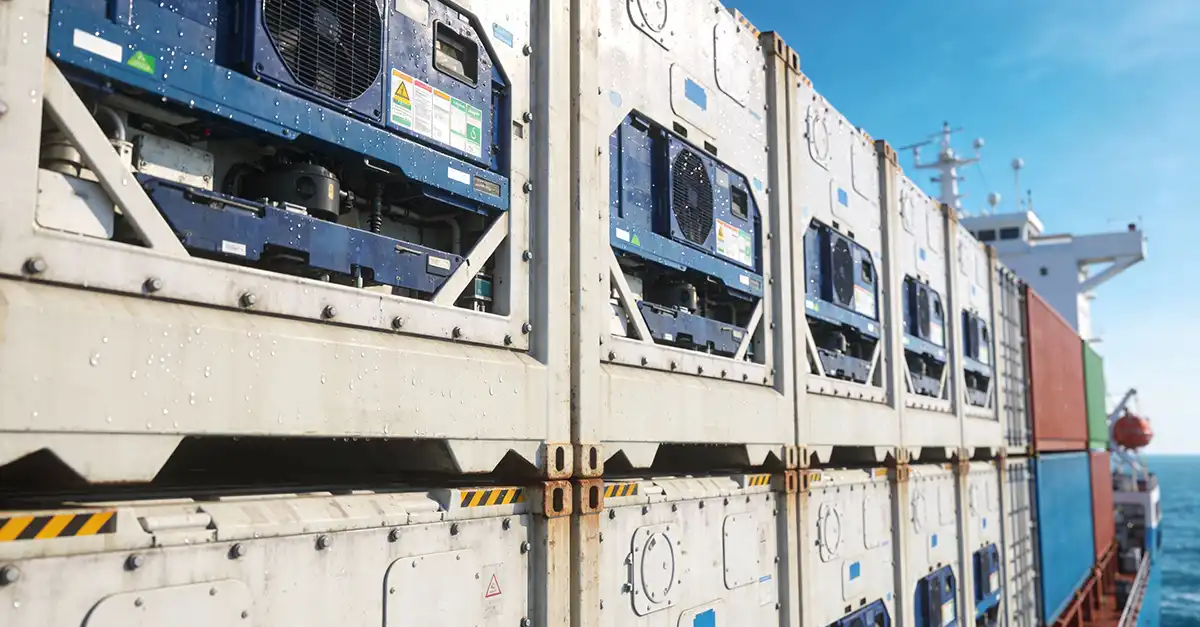
The Importance of Actual Reefer Container Capacity in Temperature‑Sensitive Exports
In the global export market for perishable commodities—from fresh fruits and vegetables to pharmaceutical and protein-based products—ensuring the availability of actual reefer container capacity has become one of the most critical determinants of operational success. Exporters face strict shipment deadlines, overseas buyers maintain precise delivery expectations, and the cargo itself is highly temperature-sensitive. Under such conditions, even a minor error during the container booking stage can result in the total loss of an entire shipment.
The central question, however, remains: do the capacities announced by some logistics providers genuinely exist, or are exporters often confronted with unsupported claims that serve merely as promotional messaging?
A Crisis of Trust in Reefer Container Bookings
Field assessments across Iran’s maritime freight market and the wider regional logistics sector indicate that many exporters have encountered the costly phenomenon of “phantom capacity.” Numerous cases have been reported where, after receiving a pro forma invoice, exporters are later informed—often for unspecified reasons—that the reserved capacity is no longer available. They are then advised to consider an alternative routing or sailing date—frequently at a moment when the cargo is already prepared and no viable alternative exists.
Such incidents not only generate financial losses but also undermine trust among stakeholders across the export and logistics ecosystem.

Causes of Unrealistic Capacity Declarations
- Lack of real-time connectivity with shipping lines:
Many intermediary logistics providers still rely on non-digital booking methods and therefore lack immediate visibility into actual equipment availability.
- Rate quotations issued prior to verifying real capacity:
Some companies announce freight rates to attract customers before confirming availability with shipping lines or their official representatives, assuming that capacity will eventually be secured.
- Multi-layered brokerage structures:
A long chain of intermediaries between the cargo owner and the actual carrier often leads to distorted or incomplete information along the communication chain.
- Absence of transparent capacity reporting standards:
The market lacks unified capacity-reporting platforms; consequently, each provider may apply its own interpretation of “available capacity.”
- Misuse of technical terminology:
In many instances, “unreserved capacity,” “potentially obtainable capacity,” or even “capacity under inquiry” are incorrectly presented as confirmed space. In operational terms, none of these represent guaranteed shipment capacity.
- Capacity declarations without alignment with customs routing or port discharge schedules:
Some capacities exist only nominally on paper; however, due to customs entry restrictions or port operational constraints, they cannot be practically utilized.
Consequences of Delay or Lack of Capacity Transparency
- Loss of destination market opportunities:
Many importing markets purchase temperature‑sensitive products only within specific seasonal windows.
- Physical spoilage of cargo:
Shipment delays can cause severe quality deterioration or complete spoilage, particularly in exports such as fresh vegetables, dairy products, meat, and vaccines.
- Additional handling and cold storage costs:
If a shipment is cancelled or rescheduled, the cargo must remain in cold storage or undergo repacking procedures.
- Damage to exporter credibility:
Foreign buyers may cancel contracts or impose conditional payment terms.
- Higher insurance exposure and delay penalties:
Insurance providers may reject full compensation if negligence in selecting the logistics service provider is demonstrated.
- Impact on future contracts:
A single logistical failure can prompt an importer to shift future contracts to competing suppliers.
What Information Should Be Verified Before Booking?
- Real‑time confirmation from the shipping line (or a reputable NVOCC) regarding actual container availability
- Vessel name, voyage number, and precise ETA at both loading and discharge ports
- Reefer container specifications (manufacturer brand, net capacity, year of manufacture, emergency power capability)
- Temperature management protocol (set point, alarm sensors, and temperature log reporting)
- Port operational conditions on the loading date (availability of power plugs in the yard, customs capacity, mandatory pre‑entry sealing requirements)
- 24‑hour cargo tracking capability throughout the transit period
Real Case Study: A Citrus Exporter in Bandar Abbas
One of Farryn’s clients—a fresh citrus exporter shipping to Southeast Asia—initially negotiated with several intermediaries and was eventually offered what was described as “available capacity,” which was cancelled after three days of waiting.
In contrast, Farryn arranged confirmed reefer containers within less than six hours of the initial inquiry, providing both container numbers and vessel details, and dispatching the equipment to the loading site.
The outcome was straightforward: shipment executed on schedule, customer satisfaction in the destination market, and renewal of the seasonal supply contract for the following year.
Comparison with Developed Markets
In leading export-oriented economies such as Chile, the Netherlands, and New Zealand, access to reefer container capacity is available in real time through official government platforms or logistics consortium systems. In these markets, critical shipping data—including ETA, ETD, container type, utilization history, and container age—is accessible before booking decisions are made.
These operational models could serve as a blueprint for the transformation of Iran’s refrigerated logistics sector, provided that private‑sector stakeholders invest seriously in digital infrastructure and commit to transparency.

Farryn Sahel Arvand: A Choice Based on Real Capacity and Full Transparency
Leveraging direct access to major shipping lines and an intelligent booking infrastructure, Farryn Sahel Arvand provides exporters with verified reefer container capacity at the required time. Unlike the promotional and opaque practices observed in parts of the market, Farryn adopts a transparent, documented, and advisory-driven approach when communicating freight rates and delivery schedules.
The company’s track record of cooperation with exporters of dates, citrus fruits, shrimp, dairy products, and pharmaceuticals across Asian and Latin American trade lanes reflects its technical capability and operational reliability.
In the volatile landscape of international trade, actual reefer container capacity is not merely a figure on a pro forma invoice—it is a critical benchmark for protecting cargo value, maintaining buyer confidence, and sustaining export continuity.
For exporters seeking a dependable service, documented capacity confirmation, and genuine logistical support throughout the shipping process, Farryn Sahel Arvand stands ready to ensure that export operations proceed with certainty and transparency.