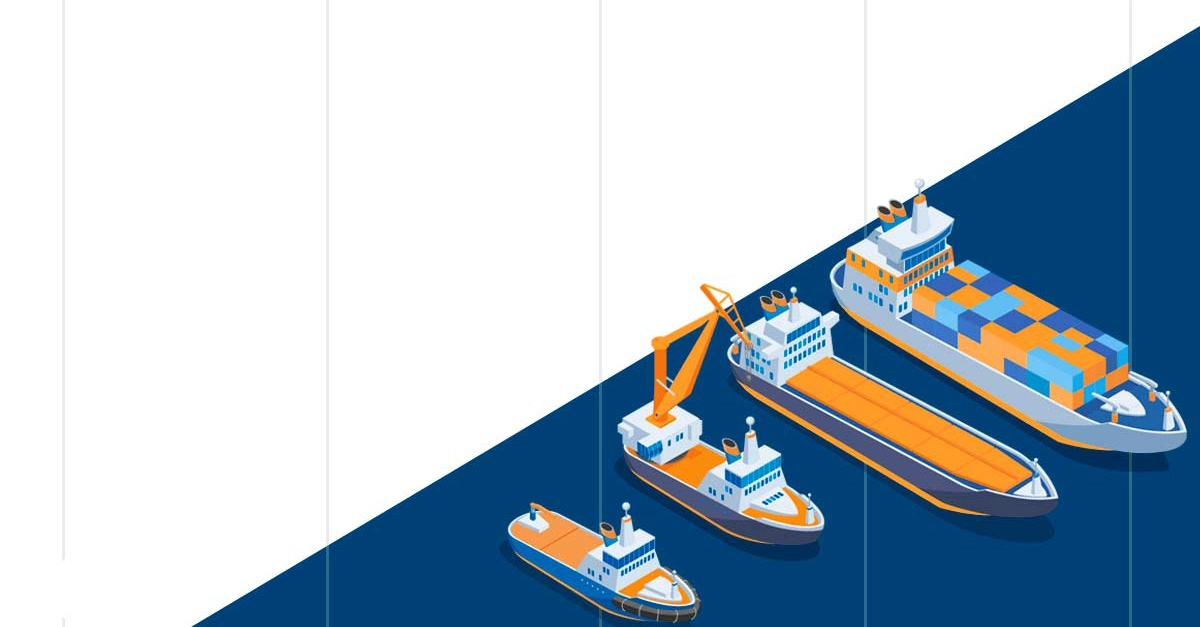
Everything You Need to Know About Types of Vessels in Maritime Transport; From Tankers to Container Ships
Every day, millions of tons of goods are transported worldwide, and this movement is facilitated by vessels specifically designed for distinct purposes. Given this diversity, the question arises: which type of vessel should be selected for transporting shipments?
In this article, we seek to familiarize you with the various types of cargo vessels in maritime transport so that you can make more informed decisions.
Types of Maritime Cargo Vessels
The maritime transport fleet comprises a wide range of vessels. Each ship is designed with unique technical specifications and structural features, making it suitable for transporting specific types of cargo. Below are some of the most commonly used vessel types:
1) Container Vessel
Container ships can be regarded as the most significant segment of maritime transport. These vessels are specifically constructed for carrying containers—metal enclosures in which cargo is placed and systematically arranged aboard the vessel.
The use of standardized containers has streamlined the processes of loading, discharge, handling, and even warehousing, making them more efficient and secure than ever before. These units are manufactured in various configurations, ranging from refrigerated and flat-rack containers to specialized tank containers designed for liquid cargo. This diversity has enabled a wide range of goods to be transported efficiently via container vessels.
But how many containers can a container ship accommodate? The capacity of these vessels is measured in TEU (Twenty-foot Equivalent Unit), which corresponds to one 20-foot container. Based on this capacity, maritime routes, and port infrastructure, container ships are classified into several categories:
Feeder
These vessels operate between local and main ports. They are relatively small in size and typically have a capacity of up to 3,000 TEU.
Panamax
Panamax vessels generally have a capacity of approximately 3,000 to 5,000 TEU and are designed in accordance with the dimensional constraints of the Panama Canal. They are commonly deployed on routes transiting the Panama Canal.
PostPanamax
These vessels have a capacity ranging from 5,000 to 10,000 TEU and exceed the traditional Panama Canal size standards. Consequently, they are primarily utilized in deeper and more advanced ports.
Ultra Large Container Ships
Ultra-large container vessels are massive ships with capacities exceeding 14,000 TEU, with some accommodating up to 24,000 TEU. These ships are designed for intercontinental routes and can berth only at ports equipped with advanced facilities and sufficient depth.
2) Dry Bulk Carrier
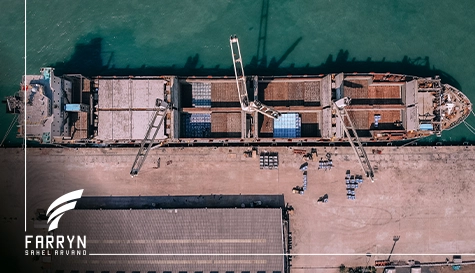
Dry bulk carriers represent one of the most important vessel types in maritime transport. They are used for transporting dry bulk commodities such as wheat, corn, rice, coal, iron ore, bauxite, cement, and mineral fertilizers. These goods are carried without packaging and are loaded into large, watertight holds integrated into the vessel’s structure. Loading and discharge operations are typically conducted using conveyor belts, grab cranes, or suction systems.
Dry bulk carriers are constructed in various sizes and capacities:
Handysize
Handysize vessels have a capacity of less than 40,000 tons. Due to their relatively small dimensions, they are capable of accessing smaller and shallower ports and are therefore commonly used for regional trade routes or specialized shipping operations.
Panamax
Panamax vessels have a capacity ranging between 60,000 and 80,000 tons and are designed to transit the Panama Canal.
Capesize
Capesize vessels, with capacities exceeding 100,000 tons, are among the largest types of bulk carriers. Due to their substantial dimensions, they are unable to pass through the Panama or Suez Canals and operate primarily on long open-sea routes, such as those via the Cape of Good Hope.
3) Tanker Vessel
Tanker vessels are highly suitable for transporting liquids and gases and, depending on the nature of the cargo and tank design, are categorized into three main types:
Oil Tanker
These tankers are used for transporting crude oil and refined petroleum products and typically have very large capacities. Many are equipped with inert gas systems to reduce the risk of fire and explosion. By injecting inert gases such as nitrogen into the empty tank spaces, this system lowers oxygen concentration and prevents the ignition of flammable vapors.
Gas Carrier
These tankers are specifically designed for the transportation of liquefied natural gas (LNG) and liquefied petroleum gas (LPG). Their double-walled and reinforced tanks prevent accidents caused by leakage or structural failure and maintain pressure and temperature to avoid phase changes in the gas.
Chemical Tankers
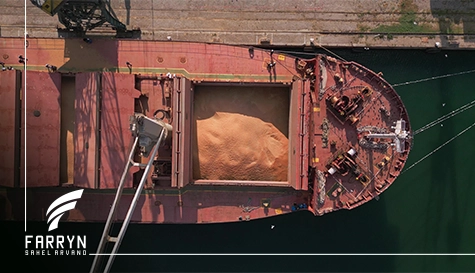
These vessels are designed for the transportation of chemical or food-grade liquids, such as vegetable oils. They are typically equipped with multiple independent tanks, predominantly constructed from stainless steel. To prevent chemical reactions or contamination, each substance is stored in its designated tank.
Chemical tankers are classified into three categories—Type 1, Type 2, and Type 3—based on tank safety standards. Type 1 offers the highest level of protection and is used for highly hazardous substances, whereas Type 3 is suitable for lower-risk cargoes.
4) Refrigerated Vessel (Reefer Vessel)
Reefer vessels are specifically engineered for the transportation of perishable and temperature-sensitive goods. These ships are fitted with integrated refrigeration systems capable of independently regulating and maintaining stable temperatures within each cargo compartment. This functionality is critical for transporting fresh fruits, vegetables, meat, dairy products, pharmaceuticals, and seafood, all of which require precise and consistent temperature control to preserve quality.
With the widespread adoption of refrigerated containers, the use of dedicated reefer vessels has declined. Today, they are primarily employed for cargo requiring exceptionally strict temperature management. Some models are also equipped with continuous temperature monitoring systems and automated alert mechanisms in case of system irregularities.
5) Breakbulk Vessel
Certain cargoes possess irregular dimensions and substantial weight, rendering them unsuitable for containerization. At the same time, they are not transported in loose form like bulk commodities. In such cases, breakbulk vessels provide an effective solution.
Cargoes such as industrial machinery, power plant equipment, turbines, steel ingots, raw timber, flour, sugar, or bagged cement are packaged in sacks, crates, pallets, rolls, or drums and systematically stowed on deck or within cargo holds for transport.
These vessels are generally equipped with onboard cranes or specialized heavy-lift equipment. Consequently, they can conduct loading and discharge operations even at ports with limited infrastructure. This capability has positioned breakbulk vessels as a primary option for project cargo and shipments to regions lacking advanced port facilities.
6) RoRo Vessel
RoRo vessels are designed for the transportation of wheeled vehicles such as automobiles and railway wagons. Their decks are typically multi-level and flat, with internal layouts resembling multi-story parking structures.
Unlike many conventional cargo vessels that require cranes for loading, vehicles on RoRo vessels can simply drive on and off via dedicated ramps. This facilitates rapid and efficient loading and discharge operations without the need for complex equipment or extensive labor.
RoRo vessels are further categorized based on cargo type and operational purpose:
- PCC (Pure Car Carrier): These vessels are exclusively designed for transporting passenger vehicles and do not accommodate cargo or passengers. They feature multiple fixed-height decks and are commonly deployed on international vehicle transport routes.
- PCTC (Pure Car and Truck Carrier): These vessels are equipped with adjustable decks and can transport not only passenger vehicles but also trucks, buses, and other heavy vehicles.
- RoPax (Roll-on/Roll-off + Passenger): RoPax vessels are capable of carrying both vehicles and passengers, with dedicated sections allocated for each. They are typically used on short-distance routes between high-traffic ports.
- ConRo (Container + RoRo): These multipurpose vessels allocate part of their capacity to containerized cargo and the remainder to vehicle transport. They are primarily deployed on routes involving mixed cargo, where optimal space utilization is essential.
7) Multipurpose Maritime Transport Vessel
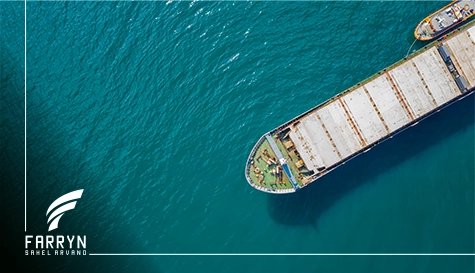
As the name suggests, this vessel is designed to accommodate various types of cargo. Depending on the nature of the shipment, dedicated cargo spaces are configured within the vessel, enabling the simultaneous transport of containerized, bulk, breakbulk, and even heavy-lift or oversized cargo.
Multipurpose vessels typically operate on routes characterized by diverse cargo profiles or limited port infrastructure. Consequently, they are widely utilized on regional routes or in less-developed ports. These vessels represent a practical solution for companies requiring the transportation of mixed cargoes, as they eliminate the need to charter separate vessels for each cargo category.
8. Barge
Barges are non-self-propelled vessels that move with the assistance of tugboats. They generally feature flat bottoms and low sidewalls and are used for transporting heavy or oversized cargo over short maritime or inland waterway routes. Barges are predominantly employed in ports or coastal areas where the movement of substantial cargo volumes is required.
9. Livestock Carriers
As the name suggests, this vessel is designed to accommodate various types of cargo. Depending on the nature of the shipment, dedicated cargo spaces are configured within the vessel, enabling the simultaneous transport of containerized, bulk, breakbulk, and even heavy-lift or oversized cargo.
Multipurpose vessels typically operate on routes characterized by diverse cargo profiles or limited port infrastructure. Consequently, they are widely utilized on regional routes or in less-developed ports. These vessels represent a practical solution for companies requiring the transportation of mixed cargoes, as they eliminate the need to charter separate vessels for each cargo category.
Smart Selection in Cooperation with Farin Sahel Arvand
We have introduced the various types of cargo vessels in maritime transport and examined their respective capabilities, applicable routes, and the types of goods they are designed to carry. Undoubtedly, making the right selection requires a careful assessment of cargo specifications, transportation routes, and the available budget.
In this regard, we can also seek specialized consultation from the experts at Farryn Sahel Arvand. Based on our specific requirements, they provide cost-effective and optimized logistical solutions.